Dental clinic on Skid Row gives care to homeless community
LOS ANGELES — People experiencing homelessness often face several barriers to professional dental care.
Barriers include the cost of services, limited providers, discrimination and competing needs — as many are in survival mode.
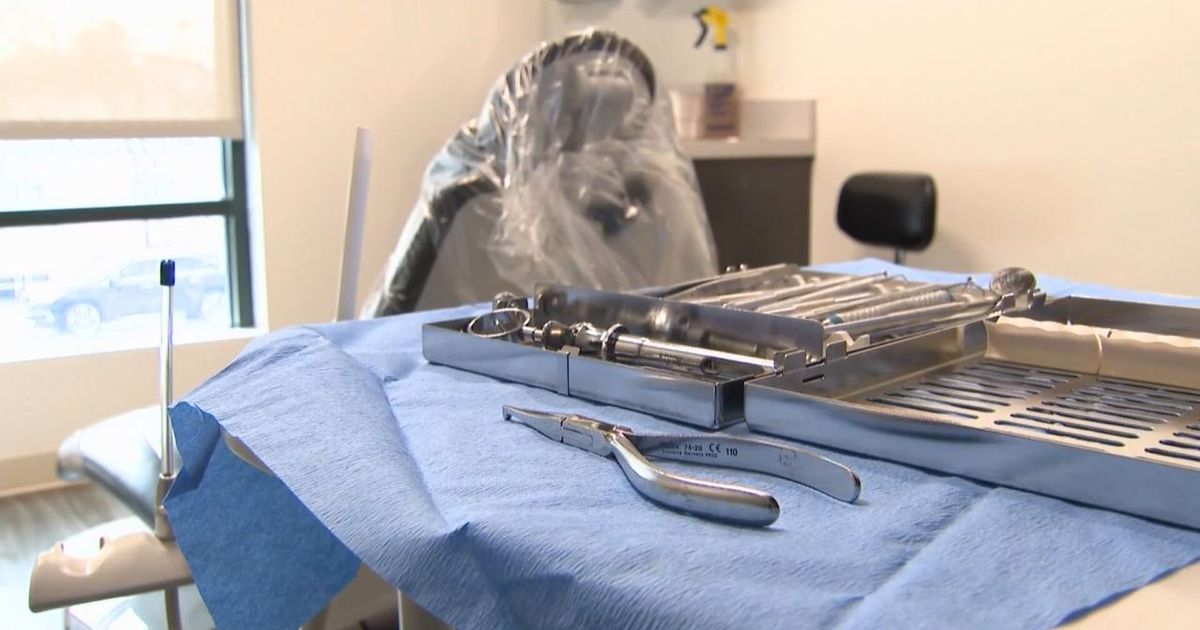
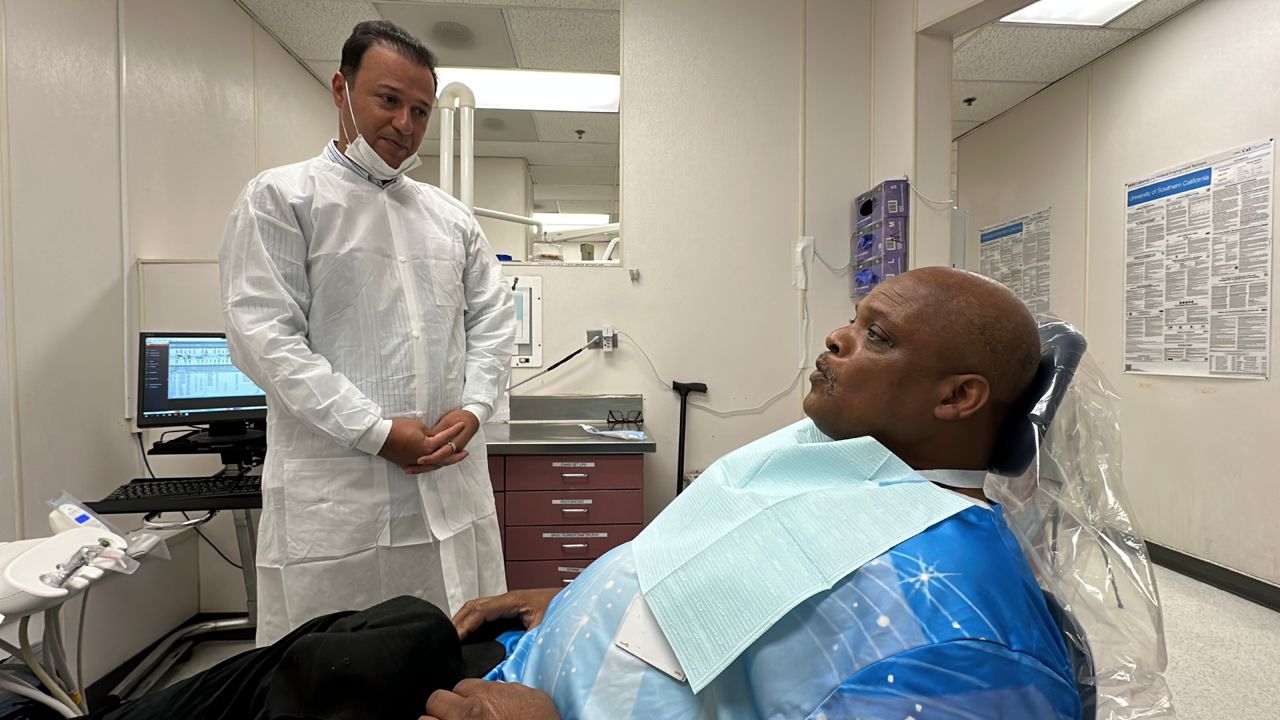
That is why, in the heart of Skid Row, the USC Dental Clinic located inside the Union Rescue Mission is working to give people the health and confidence to better their life situation.
It’s something patient Dwayne Lewis can attest. He says he had completely lost all his teeth before falling into homelessness because of his deteriorating health and drug abuse issues.
“I had to put my hand over my mouth, had to talk with my head down, or there was times they called on me to speak and I had to decline because I had no teeth. So it was a mental struggle,” he said.
But while living at the Union Rescue Mission shelter, he found out the USC Dental Clinic on the floor right above provided free dentures as a service. And he immediately signed up.
Lewis was able to get a full set of dentures for his lower and top teeth, completely changing his lifestyle now.
“When I go out in public, I get great compliments. People think they are my real teeth,” he said.
That confidence Lewis has gained back is priceless, but dentures usually are not. Costs depend on the patient, but on average people can expect to pay thousands of dollars. Despite working in construction for over 20 years, that was extra money that Lewis just did not have. He said that already just scraping by when he was working; it was actually a medical bill that left him homeless and living on Skid Row.
“I got a bill like $5,000. And it was just it was unbearable,” said Lewis.
It’s cases like Lewis’ that led to the USC School of Dentistry to partner with the Union Rescue Mission over 25 years ago to tackle this issue among people experiencing homelessness.
There are other dental providers located on Skid Row providing dental services, but this clinic has the ability to do more complicated procedures such as root canals, tooth extractions and dentures, along with the basic cleanings and fillings.
Clinic Director Dr. Medhi Mohammadi said dental care often seems out of reach for people living on the street.
“Many don’t know where they’re going to get their next meal or where they’re going to sleep. When it comes to oral hygiene unfortunately, that is not the priority anymore. And over time, they stop taking care of the teeth, and then they started getting cavities and gum diseases,” said Mohammadi.
Mohammadi said hygiene maintenance is also difficult, as many don’t have either a toothbrush and toothpaste, or a place to brush their teeth.
That’s why having that understanding is so important for future dentists to have, and why the clinic is part of the training for USC dental students, who are supervised by the licensed USC faculty.
“USC campus is just three miles south of the Skid Row, so this is considered part of our neighborhood and part of our community,” said Mohammadi. “So we want to take care of our neighborhood, and then we are happy other students are coming and learning how to serve the underserved.”
It’s a message students like Somkene Okafor-Okwuego take with them as they see patients.
“We really get to see firsthand the challenges and also what it means to have a lack of access to care here,” she said. “And I think it kind of reminds us that empathy is such a huge, important function in our job, because at the end of the day, even though it’s great to have hand skills and the knowledge, it’s really about like who we can, you know, provide care to.”
Okafor-Okwuego has been volunteering at the clinic since her freshman year, but now as a senior, she is part of the new cohort completing the mandatory clinical rotation this semester.
“It’s really prepared me for is quickness and adaptability,” she said. “Personally, because I’m seeing people from cosmetic cases to pain to just needing functionality stuff, it really has made me adapt quickly.”
Mohammadi was also a student at the clinic before working and becoming director, and says seeing the everyday impact they have on patients like Lewis is a driver in their work.
Now at 64, Lewis — with his new set of teeth — has a job and is looking ahead.
“I have a bank account with money in it. I’m able to go to the bank,” he said. “I’m able to look at the teller and smile at the teller and say, ‘Thank you.’”
link